SignaLex
AI Medical Board for Preventive Health
Seven specialist AI agents review every patient's complete record — not just the panel drawn today — and hand your physician a ranked, fully traceable brief before the consultation begins.
AI Medical Board for Preventive Health
Seven specialist AI agents review every patient's complete record — not just the panel drawn today — and hand your physician a ranked, fully traceable brief before the consultation begins.
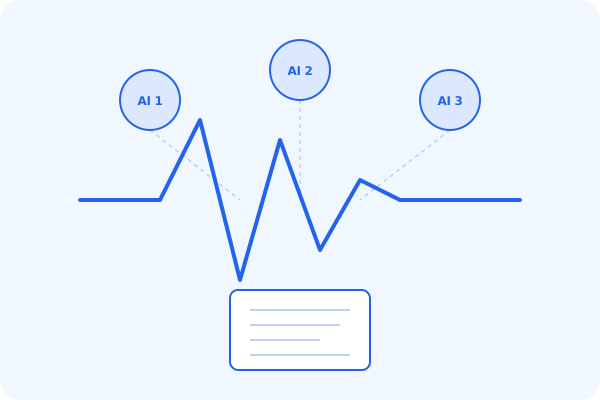
Seven AI specialists read each patient's entire record — every past report they have ever uploaded — and surface the correlations no single report can show
Labs, imaging reports, prescriptions, scanned notes and handwritten pages — OCR'd, structured and analysed together. One patient in our validation set: 33 documents, 488 specialist reviews, one analysis run.
Cardiology, internal medicine, neurology, pulmonology, gastroenterology, endocrinology and family medicine each review the full record independently — then a consensus engine ranks findings by agreement.
Your physician opens the patient already knowing the story: what was flagged, by whom, traced back to the source document, date and value. No workflow step is added.
Specialist AI agents reviewing simultaneously
Documents analysed in a single patient record
Cross-document patterns found in one record
The result is not a detection failure. It is a correlation failure.
The patient feels well. The consultation is short, reassuring and structured around today's numbers — because today's numbers are what is in front of the physician.
Values inside reference range are reported as normal. A result that is normal today but has been drifting for four years is still reported as normal.
Prior reports sit in the archive, often as scans and photographs. Nobody reads a decade of PDFs inside a fifteen-minute review.
The lipid panel, the thyroid panel, the ultrasound and the urinalysis are read by different people, on different days, against different reference ranges.
It adds nothing to your workflow — it sits between the lab result and the consultation
You share de-identified checkup records — or the patient uploads them. No EHR integration required to start.
Seven specialists review every document. Results in seconds, at our cost, for every patient in the cohort.
Each flagged finding goes to your clinical team. They confirm it as actionable, or they reject it.
An invoice is raised only for findings your physicians confirm. Everything else is free, including the rejects.
The findings that live between documents — patterns that no single report could have contained
All seven run concurrently, so a full board review of a complete record completes in seconds — fast enough to sit inside the checkup pathway.
A finding six specialists raise independently ranks at the top. A finding one raises still surfaces, weighted low. Agreement is the noise filter.
Every finding carries the specialist that raised it, the document it came from, the date and the value. Nothing is generated that is not in the record.
The board re-reads the entire history every time a new document arrives — a value drifting across four years, a finding raised once and never followed up.
In our validation set, one finding was supported by 23 corroborating records. Your physician can open any one of them from the flag.
Each flag stays open until a clinician marks it: being treated, resolved, or dismissed. The system tracks the decision — it never makes it.
Low clinical risk, high clinical value — and measurable from day one
People arrive feeling well, with nothing to investigate. If there is a signal, it is in the trajectory across their past reports — precisely what a single visit cannot see.
A checkup programme accumulates years of labs, imaging and prescriptions per patient. The raw material the board needs is already in your archive.
These are advisory flags on asymptomatic patients, reviewed by your own physicians before anything happens. There is no acute pathway to disrupt.
"Seven AI specialists review your entire medical history, not just today's tests" is a line no competing checkup package in your market can print.
A confirmed finding becomes a warranted referral, imaging order or specialist consult — care that today leaves the building undetected.
Confirmed-finding rate, physician time saved, false-positive burden. You will know within 90 days whether it works.
Free analysis. You pay only for findings your own doctors confirm.
For the analysis, at any volume
Per physician-confirmed actionable finding
If your doctors confirm nothing at all
No integration cost. No minimum commitment. No auto-renewal. If the pilot produces nothing your clinicians value, you owe nothing.
You have no way to know in advance whether the board finds anything in your population. Neither do we. Paying per confirmation puts that risk on us.
You choose: ~$5 per patient per month under continuous analysis, or ~$600 per physician per year. Priced to scale, not to extract.
Three phases, no live data until you say so
You give us 50 de-identified historical checkup files — ideally patients whose condition was picked up late. We run the board and present what it found against outcomes you already know. Zero patient risk, zero cost.
500 consenting health-checkup patients. Briefs are generated before each consultation. Your clinical champion reviews every flag and marks it confirmed, already known, or rejected. We invoice only for confirmations.
We sit down with the numbers: confirmed-finding rate, physician time on history review, false-positive burden, clinician NPS. You decide whether to convert, extend, or stop.
SignaLex is clinical decision support, not a diagnostic device. It surfaces and ranks; it does not diagnose, prescribe, order or triage.
Every finding is a suggestion for a clinician to evaluate independently. No result is presented to a patient without your physician's review.
Specialist that raised it, source document, date, value. A clinician can open the underlying record from any finding in one click.
The system cannot generate clinical data that is not in the patient's documents. It correlates what exists; it does not infer beyond it.
Each finding carries a confidence score and the degree of specialist agreement behind it — so weak signals are visibly weak.
Confirmed, already known, being treated, or rejected — your team's disposition is recorded against every flag and drives what we invoice.
Built to operate as decision support with independent physician review, under your existing clinical governance framework rather than outside it.
Your patients' records are never sold, never shared with another institution, and never used to train third-party models. The data stays yours.
Every document passes through medical entity extraction and PHI detection at ingestion, before any language model processes it.
AWS KMS auto-rotating keys at rest across all data stores; TLS 1.2 or higher in transit. No unencrypted storage anywhere in the pipeline.
Row-level authorisation. No API path allows one patient's record to reach another's context.
Every data mutation and every service call is logged and traceable. Audit trails are available to your compliance team on request.
Phase 1 touches no live patient data at all. Live records only enter the pipeline after a signed agreement and patient consent under your own process.
Export and deletion workflows are live. A HIPAA Business Associate Agreement is executed with our infrastructure provider, and an institutional agreement is ready for you.
We built a medical board out of software. It needs doctors.
When does a value drifting inside the reference range become clinically meaningful, and when is it noise? Our agents reason from published cut-offs. You reason from patients.
A finding can be entirely correct and still waste a physician's attention. We need to learn where that line sits in your specialty.
Read the cardiology agent's output and tell us whether a cardiologist would have framed it that way, prioritised it that way, or asked a different question first.
Our confidence and severity scores are mathematical — agreement counts and overlap ratios. They are not yet clinical. We need clinicians to tell us what should escalate.
Specialties we are looking for now: Cardiology, Internal medicine, Neurology, Pulmonology, Gastroenterology, Endocrinology, Family medicine — and as the board expands, urology, nephrology, oncology and haematology.
Join the Advisory BoardSteps 3 and 4 are the only ones we touch in your checkup pathway
Records can be shared as files, or uploaded by the patient. FHIR R4 connectors exist for Epic, Cerner and Athena when you want them, and map onto ABDM-compliant HMIS.
The brief is a document. It can arrive in your existing system, by secure link, or printed with the checkup file.
Nothing about your checkup product changes — except that it now carries a claim no competing package can make.
A 30-minute conversation. Then 50 files from your own archive. We run the board and show you, on your own records, what was already there. No live patient data is touched.
Contact Us: signalex@3ai.tech